|
Drug Free Australia is a peak body, representing organizations and individuals who value the health and wellbeing of our nation. It plays a key role as a community voice, staying in touch with every day Australians - families and young people - via newsletters, community forums and the media, to ensure a clear message of healthy, drug free lifestyles is assured for generations to come. more …
Drug Free Australia's Position Statement
Drug Free Australia's Position Statement Against Illicit Drug Legalisation, Regulation and Decriminalisation is supported by more than 185 NGO's and individuals. This number is growing daily.
We support a balanced and humane illicit drug policy that aims at primary prevention and recovery-based treatment and rehabilitation. This can never be achieved if illicit drugs are condoned through their legalisation. Legalisation equates to ‘regulation’ in the illicit drug context.
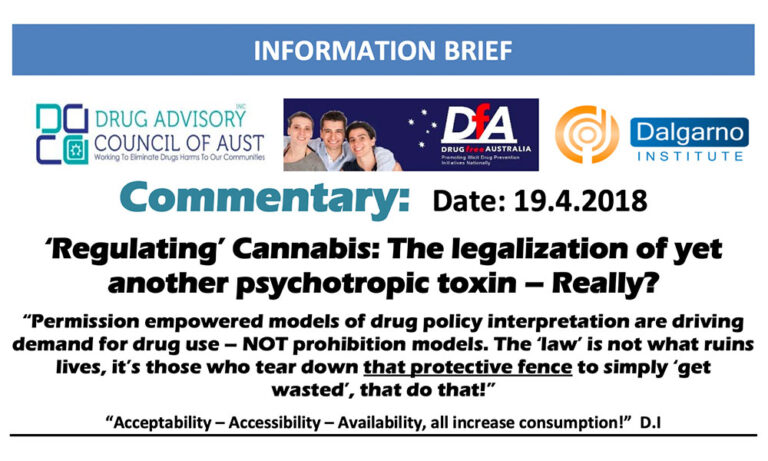
There is a maxim that remains constant - 'availability, accessibility and permissibility will increase consumption’
The Position Statement is available here
Browse the growing list of supporters and NGOs supporting this Position Statement.
To add your details to the list, click here
Given the overwhelming evidence on the harms associated with cannabis, we conclude that governments and society should stand firmly against any change that would relax the law on the use of cannabis for medical purposes.
The research paper is now available
New drug prevention website launched: Go to www.dontdecriminalize.org
INCB President voices concern about the outcome of recent referenda about non-medical use of cannabis in the United States in a number of states
Recent debate on policy options for tackling the use of illegal drugs has stressed the merits of viewing drug use as a health rather than a criminal justice matter. However, there are strong reasons for avoiding an ‘either or approach’ to drug enforcement and treatment and viewing these as complementary rather than as competing approaches to tackling the use of illegal drugs. This article draws upon data from an evaluation of three major drug enforcement operations to show that in the aftermath of those operations, the proportion of drug users contacting drug treatment services markedly increased. The implications of these results are that those planning drug enforcement operations should involve staff within drug treatment agencies to ensure that any increased demand for their services, in the aftermath of drug enforcement operations, can be met. Further, the research shows the merit of viewing drug enforcement and treatment as complementary elements of a comprehensive drug strategy.
Dr Gregory K Pike, Director, Adelaide Centre for Bioethics and Culture has produced an important paper discussing the debate surrounding drug law reforms.
The paper is now available for download.
Did Australia21 get anything right? Gary Christian from Drug Free Australia conducted a presentation discussing Australia21 program. The presentation is available for review here.
Drug decriminalization in Portugal is a failure despite of various reports published all over the world pretending the opposite. There is a complete and absurd campaign of an unacceptable manipulation of Portuguese drug policy. Manuel Pinto Coelho MD, PhD out lines the complete history. The report is available for viewing here.
These graphs give the overall picture of Portugal drug use.
|